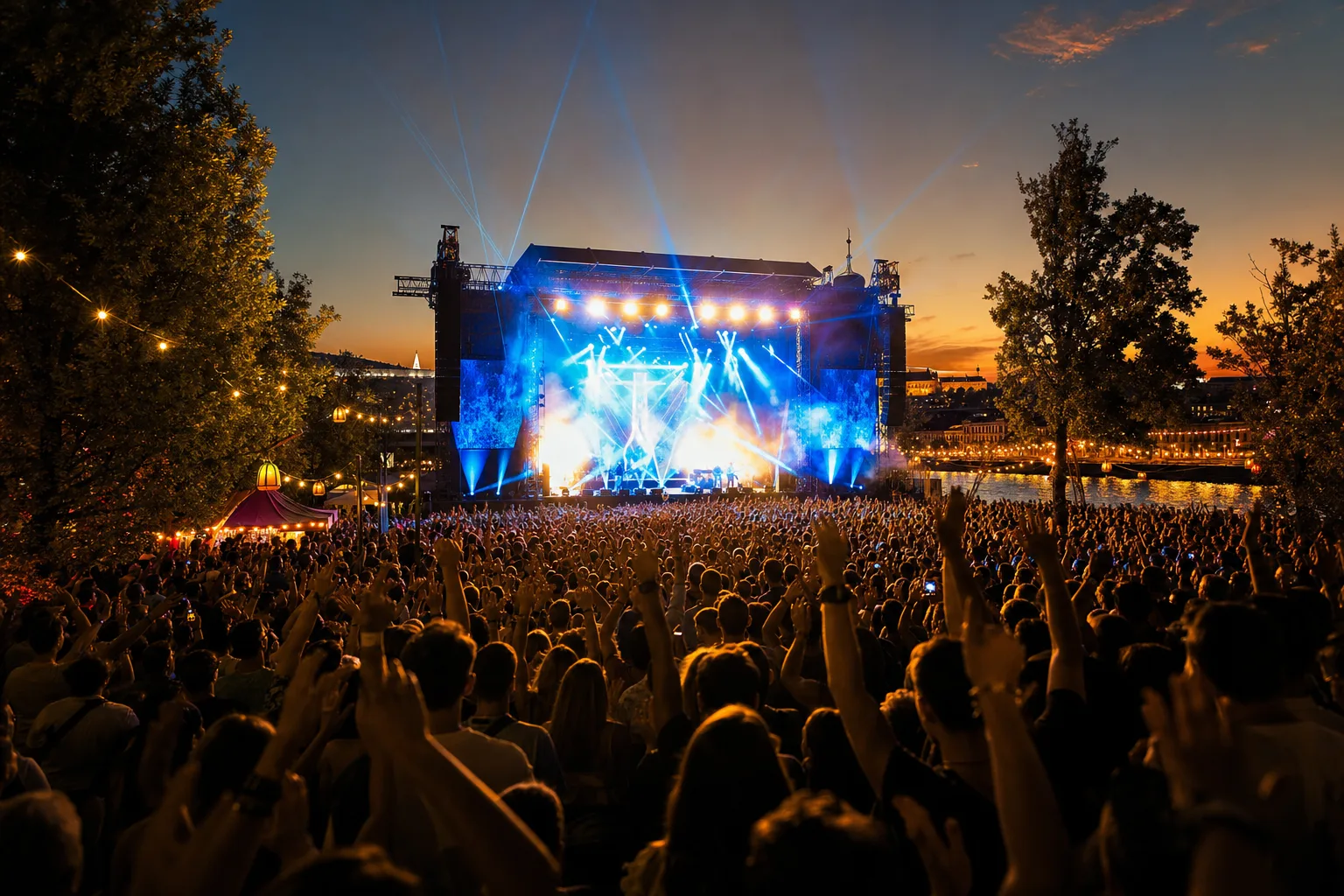
Every August, a green island in the middle of the Danube transforms into one of Europe's most electric gatherings. Sziget Festival — the name simply means "island" in Hungarian — has spent three decades earning its nickname, the Island of Freedom. For five days and nights, Budapest's Óbuda Island becomes a self-contained city of music, art, light and a kind of joyful chaos that pulls in more than half a million people from over a hundred countries.
If 2026 is the year you finally join them, this guide is written for you. We will cover the dates, the lineup, how tickets and passes actually work, the real differences between camping on the island and sleeping in the city, how to reach the site without stress, the all-important cashless payment system, what to pack, and — because Sziget is only half the story — how to make the most of Budapest itself when the music stops. Whether it is your first festival abroad or your tenth, the goal here is simple: spend less time confused and more time dancing.
What Is Sziget Festival? The Island of Freedom
Sziget began in 1993 as a modest student gathering and grew, year by year, into one of the largest and most respected music festivals on the continent. Today it sits comfortably alongside Glastonbury, Roskilde and Primavera in any serious conversation about Europe's great summer events — but it has a personality all its own.
What sets Sziget apart is that it is not only a music festival. Yes, the main stage hosts globe-conquering headliners, and yes, the electronic arenas thump until sunrise. But woven between the concerts you will find a circus tent, a theatre programme, an art zone full of interactive installations, yoga and wellness sessions, talks and workshops, a beach on the Danube, and quiet corners where you can simply lie in the grass and watch the light change. People describe Sziget less as an event you attend and more as a temporary country you move into for a week — one with its own rhythm, its own currency and its own unwritten code of openness and tolerance.
That spirit is the real draw. The crowd is famously international and famously friendly. Solo travellers thrive here. Strangers become tablemates, then dance partners, then friends you stay in touch with for years. If you have ever felt that big festivals can be impersonal or tribal, Sziget tends to be the opposite: a place built deliberately around the idea that everyone belongs.
Sziget 2026: Key Dates and Location
Sziget Festival 2026 runs from Tuesday 11 August to Saturday 15 August 2026. The festival takes place, as always, on Óbudai-sziget (Óbuda Island), a leafy island in the Danube in the north of Budapest, technically part of the city's third district.
The timing is part of the magic. Mid-August in Budapest is reliably warm — daytime highs typically sit in the high twenties to low thirties Celsius — with long, golden evenings that stretch past nine o'clock. Pack for heat and sun during the day, but throw in a light layer for the small hours, when the riverside air finally cools and the after-parties are still going strong.
Because the site is an actual island inside a capital city rather than a remote field hours from anywhere, Sziget offers something most mega-festivals cannot: you are never more than a short train ride from cafés, pharmacies, air-conditioned hotels and a thousand years of history. That proximity shapes every decision you will make below, from where you sleep to how you travel.
The 2026 Lineup: Who's Playing
Sziget's programming is famously broad, deliberately refusing to chase a single genre. The 2026 edition continues that tradition with a headline roster that spans arena rock, pop, indie and electronic music, anchored by names such as Florence + The Machine, Twenty One Pilots, Bring Me The Horizon and Lewis Capaldi.
Around those marquee acts sits the depth that long-time Sziget-goers prize: artists like Zara Larsson, Wolf Alice, Biffy Clyro, Loyle Carner, Tash Sultana, Chet Faker, Parcels and Ashnikko on the live stages, and a formidable electronic bill including Underworld, Richie Hawtin, Indira Paganotto, Nia Archives, Vintage Culture and Argy carrying the night arenas through to dawn. New and rising names such as sombr and TOMORA round out a programme designed so that there is always something worth seeing, no matter your taste.
A word of strategy: do not try to see everything. With dozens of stages and hundreds of performances, the festival rewards a loose plan over a rigid schedule. Pick two or three "must-see" sets per day, mark them, and leave the rest of your hours open to wander. Some of the best moments at Sziget happen when you follow a sound you do not recognise into a tent you did not plan to enter.
Tickets and Passes Explained
Sziget's ticketing is tiered, and understanding it before you buy can save you real money. Broadly, you choose between a full-festival pass (covering all five days) and a day ticket for a single day's entry, with VIP versions of each offering upgraded facilities, dedicated bars and better stage viewing areas.
As a rough guide for 2026, day tickets start around €99, three-day passes around €235, and five-day full-festival passes around €339, with prices climbing as the festival approaches and the cheaper tiers sell out. There is also a 21-and-under full-festival pass for younger travellers. The single most useful piece of advice is this: buy early. Early Bird tickets, released roughly the previous autumn, are dramatically cheaper than gate prices and disappear quickly. If you are reading this in summer with the festival weeks away, you have missed the deepest discounts — but securing your pass now still beats waiting and risking a sell-out.
One non-negotiable rule: buy only from the official Sziget website. The festival is a magnet for ticket touts and counterfeit listings on social media and resale sites. An official ticket is the only ticket guaranteed to scan at the gate. If a deal looks too good to be true on an unofficial channel, it is.
Camping vs. Staying in the City
This is the single biggest decision you will make about your Sziget experience, and there is no universally correct answer — only the right answer for the kind of trip you want.
Camping on the Island
Camping is included with multi-day passes and is, for many, the quintessential Sziget experience. Sleeping on-site means you never have to leave: when the last set ends at sunrise, your tent is a five-minute stumble away, and the festival's energy never fully switches off around you. The options range from Basic Camping, where you pitch your own tent, through Siesta Camping with pre-pitched tents and added comfort, up to VIP and "Glamping" tiers offering private showers, lounges and real beds. There is even caravan and RV space for those arriving on wheels.
The trade-offs are the classic festival ones: communal showers, queues, heat, noise and very little sleep. If you are young, sociable and there primarily for the round-the-clock atmosphere, camping is excellent value and unbeatable for immersion.
Staying in the City
The alternative — and the choice of most travellers over about thirty — is to base yourself in a Budapest hotel or apartment and commute to the island each day. You trade some immersion for air conditioning, a private bathroom, a proper bed and the ability to genuinely recover overnight. Given that the festival site is barely fifteen minutes from the centre by train, this is far more practical here than at remote festivals.
If you go this route, where you stay matters. We break down the city's best neighbourhoods in detail in our guide to where to stay in Budapest, but in short: District V (Belváros) offers polished central convenience, District VI (around the grand Andrássy Avenue) puts you in the heart of the action, and District VII — the famous party quarter — keeps you close to the nightlife when you want to extend the evening beyond the island. For a quieter recovery base with easy transport links, the Buda side is worth considering. Our overview of Budapest's districts can help you match a neighbourhood to your style, and you can also browse curated hotel recommendations for discreet, comfortable options.
Book accommodation as early as you possibly can. Sziget week is the busiest of the Budapest calendar, and well-located rooms vanish months ahead while prices surge for the stragglers.
How to Get to Óbuda Island
Reaching the festival is refreshingly simple. The workhorse option is the HÉV suburban railway: take the H5 line and get off at Filatorigát, the dedicated festival station, from which it is a short signposted walk across to the island. From the city centre the whole journey takes roughly fifteen minutes, and trains run frequently, including extended night services during the festival.
For something more memorable, Sziget operates shuttle boats along the Danube during the event, departing from landing stages near the city centre and delivering you to the island by water — a genuinely lovely way to arrive, gliding past the illuminated Parliament and bridges as the sun sets. There are also dedicated festival buses and, of course, taxis and ride-hailing apps, though traffic around the site can be heavy at peak times.
A practical tip: buy a Budapest transport pass for the duration of your stay rather than single tickets. The city's public transport network is excellent, cheap and integrated, and a multi-day pass covers your daily HÉV runs to the island along with any sightseeing in between. Validate your ticket correctly — Budapest does run inspections — and keep it handy.
Going Cashless: The Festipay System
Here is the one logistical detail that catches every first-timer off guard: Sziget is completely cashless. Inside the gates you cannot pay with banknotes or coins for anything — not a beer, not a langos, not a phone charger. Everything runs through the festival's cash-free Festipay system.
In practice this means one of two things. You can simply tap a contactless bank card or a payment-enabled phone or smartwatch at every bar and food stall, exactly as you would in a shop. Or you can pre-load credit onto your festival wristband, either online before you arrive or at the FestiPay top-up points dotted around the site, and tap the wristband to pay. Loading your wristband can be convenient because it spares you from fishing out a card all night, but remember to check the rules for reclaiming any unused balance afterwards.
Two warnings worth heeding. First, top-up points and ATMs can develop long queues at peak hours, so sort your payment method early rather than when you are thirsty in front of a stage. Second, this is true across all of Budapest, not just the festival: Hungary's currency is the forint (HUF), not the euro, and while cards are widely accepted in the city, you should always pay in the local currency rather than accepting a card terminal's offer to charge you in euros, which buries a poor exchange rate.
What to Pack: The Essential Sziget Checklist
The right kit turns a sweaty ordeal into an easy week. Build your packing around the August heat, the long days and the cashless, refill-friendly site:
- A refillable water bottle. Free water-refill stations are spread across the site, and staying hydrated in the heat is the difference between thriving and wilting.
- A reusable cup. Sziget runs a cup-deposit scheme, so a sturdy reusable cup saves money and hassle.
- Sun protection. High-factor sunscreen, a hat and sunglasses are non-negotiable for the daytime, when shade is limited.
- Comfortable, broken-in footwear. You will walk and stand for miles. Closed shoes for the crowds, plus sandals for the riverside beach if you want them.
- A power bank. Your phone is your ticket reference, map, camera and payment device. Keep it alive.
- A light layer for the night. Even in August, the small hours by the river get cool.
- Earplugs and a few basics. Decent earplugs protect your hearing across five long days; a small first-aid kit, wet wipes and any personal medication round things out.
- A contactless card or payment phone, given the cashless system above.
Travel light otherwise. Lockers are available on-site for valuables, and the less you carry between stages, the freer you will feel.
Beyond the Music: Workshops, Art and the Sziget Spirit
It would be a mistake to spend your entire Sziget rushing between concerts. The festival's daytime programme is one of its best-kept secrets and the reason so many people return year after year.
Wander the art zone and you will find towering interactive installations and surreal statues that turn the island into an open-air gallery. There are workshops on everything from crafts to dance, daily yoga and wellness sessions to ease the previous night's excess, a dedicated circus and theatre programme, sports and games, talks and a genuinely diverse food scene drawing on cuisines from around the world. The Danube beach offers a place to cool your feet and watch the river drift by between sets.
This is where the "Island of Freedom" ethos becomes tangible. The afternoons have a gentle, communal, almost holiday-camp quality — face paint and hammocks and impromptu jam sessions — that balances the intensity of the headline nights. Give yourself at least one slow morning to soak it in.
Budapest After Dark: Beyond the Island
Sziget may be the headline act, but you are in one of Europe's great nightlife capitals, and it would be a shame not to sample the city itself on a night off or after the final set. Budapest's signature contribution to global nightlife is the ruin bar — sprawling, art-strewn drinking dens carved out of the crumbling courtyards of the old Jewish Quarter in District VII. They are unlike anything else in Europe, and our guide to the city's top ten ruin bars is the perfect place to start planning a night beyond the island.
Beyond the ruin bars, the city offers rooftop terraces with Danube panoramas, late-night thermal bath "sparties," riverside cocktail spots and intimate jazz cellars. For a complete picture of the city's summer offering — from baths and cruises to day trips and festivals — our rundown of the best things to do in Budapest this summer pairs naturally with a Sziget trip.
Many international visitors also choose to round out an evening with refined, professional company while exploring the city's nightlife. If that is part of your plan, take a moment to read our advice on staying safe and discreet and on the etiquette of being a considerate, respectful client. You can browse our featured companions for an introduction, and our contact page is always available if you would like assistance arranging a discreet, enjoyable evening to complement your festival week.
Practical Tips for First-Timers
Pace Yourself
Five days is a marathon, not a sprint. The most common first-timer mistake is burning out on day two by trying to see every set and drink every drink. Sleep when you can, hydrate constantly, eat real meals, and accept that you will miss things — that is the point. A well-paced Sziget beats an exhausted one every time.
Stay Connected
Your phone is your lifeline for the schedule, the map, your group chat and your payments. Bring that power bank, consider a local eSIM or roaming plan so you are not hunting for Wi-Fi, and agree on a physical meeting point with your group in case batteries die or signal drops in the crowd.
Mind Your Belongings
Large, friendly crowds still attract opportunists. Use the on-site lockers for passports, spare cards and anything you cannot replace, carry only what you need, and keep your phone secured. The atmosphere is overwhelmingly safe and good-natured, but a little common sense protects your week.
Learn a Few Words of Hungarian
Almost everyone at Sziget speaks English, and you will have no trouble getting by. But a cheerful köszönöm (thank you) or egészségedre (cheers) goes a long way with locals and is part of the fun of being somewhere genuinely different.
Respect the Spirit of the Place
Sziget's culture of tolerance and openness is not an accident — it is actively maintained by the people who attend. Look out for one another, leave the island as clean as you found it, and embrace the friendliness. The festival gives back exactly what you put in.
Final Thoughts: Your Week on the Island of Freedom
Sziget 2026 lands from 11 to 15 August on an island in the heart of Budapest, and few festivals reward a little preparation as richly as this one. Secure your pass early and only from the official source. Decide honestly whether you are a camper or a hotel commuter, and book your bed accordingly. Sort your cashless payment before you are thirsty, pack for heat with a refillable bottle in hand, and arrive with a loose plan rather than a rigid one.
Do that, and the rest takes care of itself. You will find your festival in the gaps between the headliners — a sunrise set you stumbled into, a conversation with a stranger from the other side of the world, an afternoon in a hammock by the Danube. And when you are ready to trade the island for the city, Budapest's baths, ruin bars and golden riverbanks are waiting just fifteen minutes away. Welcome to the Island of Freedom. Make it yours.