Few cities wear the title "City of Spas" as proudly as Budapest. Sitting on more than a hundred natural hot springs, the Hungarian capital pumps some 70 million litres of mineral-rich thermal water to the surface every single day. For nearly two thousand years — from Roman legionaries to Ottoman pashas to today's weekend visitors — people have travelled here to soak, sweat and unwind in steaming pools. If you are planning a trip in 2026, a visit to at least one Budapest thermal bath is not just a nice extra; it is one of the defining experiences of the city.
This complete guide walks you through the best thermal baths in Budapest, what makes each one special, how much they cost, when to go, and the unwritten etiquette that keeps the experience relaxing for everyone. Whether you want a grand palace of a spa, an atmospheric 16th-century Turkish bath, or a late-night pool party under the stars, there is a bath here with your name on it.
Why Budapest Is the World's Great Bathing Capital
The story of Budapest's baths is really the story of the city itself. When the Romans founded Aquincum on the Danube's western bank almost two millennia ago, they built bathhouses over the natural springs they found bubbling up from the Buda hills. Centuries later, the Ottoman Turks made bathing a cornerstone of daily life, constructing domed hammams whose octagonal pools still function today — a rare living link to 16th-century Hungary.
The golden age arrived at the turn of the 20th century. Under the Austro-Hungarian Empire, Budapest built colossal bath complexes that doubled as social palaces: neo-Baroque facades, stained-glass ceilings, marble columns and mosaic-lined pools designed to impress the aristocracy of a confident, wealthy city. Those buildings survive, and stepping into them is a little like stepping back into the Belle Époque with a towel over your shoulder.
What makes it all possible is geology. Budapest straddles a fault line where deep thermal water rises naturally to the surface, warm and heavy with dissolved minerals — calcium, magnesium, sulphate, bicarbonate and more. Locals have long sworn by these waters for aching joints, tired muscles and general well-being. Modern visitors mostly come for the sheer pleasure of it, but the sense that you are doing your body a favour is a pleasant bonus.
Széchenyi Thermal Bath: The Grand Yellow Palace
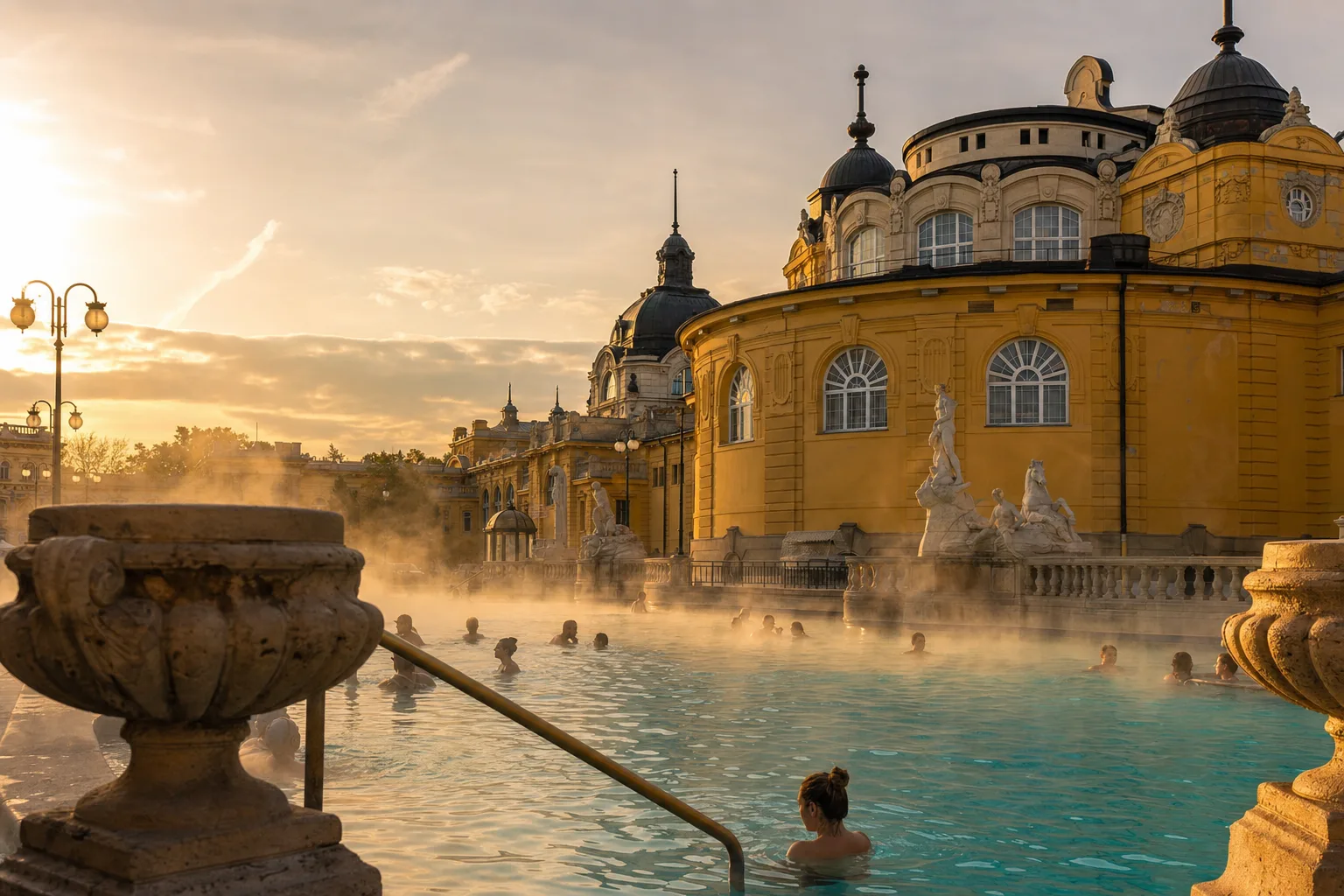
If you only have time for one bath, make it Széchenyi. Set in the leafy City Park in District XIV, this enormous mustard-yellow neo-Baroque complex is the largest medicinal bath in Europe and the image most people picture when they think of Budapest bathing. Opened in 1913, it offers 18 pools in total — 15 indoor and three outdoor — fed by two thermal springs.
The outdoor pools are the star attraction, and they are magnificent in every season. In summer the vast central swimming pool fills with sunbathers; in winter, steam rises off the 38°C water while snow settles on the balustrades and elderly locals play chess on floating boards. That contrast — hot water, cold air — is quintessentially Budapest, and it makes for unforgettable photographs.
Inside, a warren of thermal pools, saunas, steam rooms and plunge pools spreads across two floors. Water temperatures range from a bracing 18°C in the cold plunge to a toasty 40°C in the hottest thermal pool. Because Széchenyi is so large, it rarely feels unbearably crowded even when busy, and it is the easiest bath to navigate for first-timers. Massage treatments, from a quick 20-minute session to a full aroma massage, can be booked on arrival or in advance.
Gellért Thermal Bath: Art Nouveau Elegance
Where Széchenyi is grand and sprawling, Gellért is intimate and jewel-like. Attached to the historic Hotel Gellért at the Buda foot of Liberty Bridge, this Art Nouveau masterpiece from 1918 is arguably the most beautiful bath in the city. The indoor thermal pools sit beneath soaring galleries, framed by hand-painted Zsolnay ceramics, mosaic floors and a magnificent glass roof that floods the main hall with light.
The effervescent main pool, ringed by marble columns and lion-head fountains, feels like swimming inside a cathedral. Beyond it lie single-sex and mixed thermal pools of varying temperatures, saunas and a Finnish sauna, plus an outdoor wave pool that runs in the warmer months. Gellért tends to attract a slightly more international, style-conscious crowd, and it is the natural choice if you value architecture and atmosphere as much as the water itself.
One practical note for 2026: the Gellért complex has been undergoing phased renovation, so it is worth checking current opening status before you visit. When open, it remains a bucket-list experience and pairs beautifully with a stroll across to the Pest side or up Gellért Hill for the citadel views.
Rudas Baths: Ottoman History Meets a Rooftop Hot Tub
For history with a modern twist, head to Rudas, tucked beneath Gellért Hill on the Buda riverbank. At its heart is an original 16th-century Ottoman bath: an octagonal pool sitting under a domed cupola pierced with coloured glass, so that shafts of red, blue and green light fall through the steam. Bathing here genuinely feels like time travel, and the sense of ceremony is unlike anything at the larger complexes.
Rudas cleverly combines this ancient core with a thoroughly 21st-century addition: a rooftop hot tub with a panoramic view straight across the Danube to the Pest skyline and the Hungarian Parliament. Soaking in warm water at sunset with that view in front of you is one of the city's finest moments. Be aware that Rudas operates a mix of single-sex days for the historic Turkish section and mixed days for the wellness and rooftop areas, so check the daily schedule before you go — it changes through the week.
Lukács and the Local Favourites
Away from the tourist crowds, Lukács Baths in District II is where many Budapest residents actually go. Less polished and more workaday than Széchenyi or Gellért, it has a devoted local following and a slightly bohemian, old-Budapest atmosphere, its walls lined with marble plaques left by grateful bathers over the decades. Prices are lower, the crowd is more Hungarian, and the medicinal waters are taken seriously.
Other worthwhile options include Veli Bej (also known as Császár), a beautifully restored Ottoman bath offering a calm, spa-like experience at excellent value, and Király Baths, another authentic Turkish-era bath with genuine period character. If your priority is soaking somewhere quiet and local rather than snapping the perfect photo, these are the addresses to seek out.
Summer Baths: Outdoor Pools for the Warm Months
If you are visiting in July or August — peak season — Budapest offers a second category of bath built for the heat: the open-air summer strand. These lidos combine thermal pools with large recreational swimming pools, grassy lawns for sunbathing, slides and snack bars, and they are where the city goes to cool off when the mercury climbs into the mid-thirties.
The most beloved is Palatinus on Márgit-sziget (Margaret Island), a vast Art Deco lido set among the trees in the middle of the Danube. With thermal pools, wave machines, slides and acres of lawn, it is a favourite family and local destination on a hot day, and its island setting — ringed by parkland and running tracks — makes it feel like a summer resort inside the city. Dagály, on the Pest riverbank, is another large summer complex popular with locals. If you are in town during a heatwave, an afternoon at one of these outdoor strands is the authentic Budapest way to spend it, and it pairs naturally with the season’s festivals and open-air events.
The Health Angle: What's Actually in the Water
Budapest’s thermal waters are classed as medicinal because of their high mineral content, and many baths display detailed analyses of exactly which minerals each spring contains. The waters are typically rich in calcium, magnesium, hydrogen-carbonate, sulphate and sometimes fluoride and metaboric acid. Locals and doctors alike have long recommended them for degenerative joint conditions, chronic arthritis, muscular pain, and post-injury rehabilitation, and some baths still operate genuine medical wings with physiotherapy and doctor-supervised treatments.
You do not need a prescription to enjoy the benefits, of course. Even a single long soak leaves most people feeling looser, calmer and pleasantly tired — the warm mineral water eases tension out of the shoulders and back in a way an ordinary hot bath simply cannot match. A word of caution: thermal bathing raises the heart rate and can be dehydrating, so keep sessions in the hottest pools short, drink water throughout, and skip the very hot pools altogether if you are pregnant, have heart problems, or have had a lot to drink.
Best Time to Visit and Getting There
There is no bad season for the baths, but each has its own character. Winter is magical — steam pouring off the outdoor pools while snow falls is a bucket-list image — and the indoor halls feel especially welcoming. Summer brings long daylight, the outdoor strands and the Sparty nights, though the big complexes are busiest then. For the calmest experience at any time of year, arrive early on a weekday morning; weekends and mid-afternoons are the most crowded. Roughly two to three hours is enough for a satisfying visit, though it is easy to lose a whole half-day.
Getting to the baths is simple. Széchenyi sits directly above the M1 (yellow) metro line at Széchenyi fürdő station, the same historic line that runs under Andrássy Avenue. Gellért and Rudas are on the Buda riverbank, a short tram or walk from the centre, and Lukács is a quick ride north along the river. Budapest’s public transport is cheap, frequent and easy to use, so there is rarely any need for a taxi between baths.
Sparty: Budapest's Famous Bath Parties
By day, Széchenyi is a serene wellness temple. On select Saturday nights it transforms completely. The legendary "Sparty" — a portmanteau of spa and party — turns the outdoor pools into an open-air nightclub, complete with DJs, lasers, light shows and hundreds of revellers dancing waist-deep in warm thermal water. It has become one of Budapest's signature nightlife experiences, drawing stag parties, groups of friends and curious travellers from all over the world.
Sparties are ticketed events, sold separately from daytime entry and often bookable as packages with drinks. They are lively, crowded and unashamedly fun rather than relaxing — go in with the right expectations. If pool parties sound like your kind of evening, they slot neatly into a broader night out. For more ideas on where to go afterwards, our guide to the top ruin bars in Budapest covers the city's most atmospheric late-night venues.
Practical Guide: Prices, Hours and What to Bring
Ticket prices vary by bath and by day, but as a rough 2026 guide, a standard daytime entry to Széchenyi or Gellért with a locker sits in the region of 12,000–13,000 HUF (roughly €30–35), with a private cabin costing a little more. Lukács and the smaller Ottoman baths are noticeably cheaper. Buying tickets online in advance almost always saves money and lets you skip the queue, which can be long at weekends.
Most baths distinguish between a locker (a shared changing area with a lockable locker) and a cabin (a private changing cubicle). For couples or anyone who values a bit of privacy, the cabin upgrade is usually worth it. Opening hours are generous — the big complexes typically run from early morning until 7–10pm, with Sparty events running much later — but hours shift seasonally, so confirm on the day.
Here is what to pack for a smooth visit:
- Swimwear — required in all mixed areas; single-sex Turkish sections sometimes provide an apron or sheet.
- A towel — you can rent one on site, but bringing your own saves money.
- Flip-flops or pool sandals — strongly recommended for walking between pools.
- A swimming cap — required if you plan to use the lap-swimming pools (not the thermal ones).
- A waterproof phone pouch — useful if you want photos by the outdoor pools.
- A refillable water bottle — hot water is dehydrating, so drink plenty.
Bath Etiquette: How to Blend In
Budapest's baths are relaxed places, but a few conventions keep everyone comfortable. Shower before entering the pools — it is expected. Keep your voice down in the thermal and sauna areas; these are spaces for quiet recovery, not conversation at volume (the Sparty is the obvious exception). Do not dive or swim aggressively in the thermal pools, which are for soaking rather than exercise.
Be mindful of the temperature progression: the traditional rhythm is to alternate between hot thermal pools, a sauna or steam room, and a cold plunge, resting in between. Don't stay in the hottest water for more than 15–20 minutes at a stretch. Photography is generally fine in the outdoor areas but frowned upon or forbidden in changing rooms and busy indoor pools — be discreet and never photograph other bathers without consent. A calm, considerate attitude is all it takes to feel like a local rather than a tourist.
Which Budapest Bath Is Right for You?
With so much choice, it helps to match the bath to your priorities:
- First-time visitor who wants the classic experience: Széchenyi, for its scale, outdoor pools and easy layout.
- Architecture and atmosphere lover: Gellért, when open, for Art Nouveau splendour.
- History enthusiast: Rudas or Veli Bej, for genuine 16th-century Ottoman bathing.
- Best view: the Rudas rooftop hot tub at sunset, hands down.
- Budget and local flavour: Lukács, where the city's own residents soak.
- Nightlife and parties: the Széchenyi Sparty on a Saturday night.
Making It Part of the Perfect Budapest Day
The baths are best treated not as a box to tick but as the anchor of a relaxed day. A classic itinerary runs like this: a leisurely morning soak at Széchenyi, lunch and a coffee in the City Park, an afternoon exploring one of the central districts, and then dinner and drinks as the evening unfolds. Budapest is compact and walkable, so moving between bath, restaurant and bar is effortless. Choosing the right base makes it even smoother — our guide to where to stay in Budapest breaks down the districts for location and comfort, and the neighbourhood guide helps you find your bearings.
Many visitors come to Budapest for exactly this blend of wellness, culture and refined nightlife: warm thermal water by day, elegant dining and discreet entertainment by night. If you are travelling and would like the company of a sophisticated, cultured companion who knows the city well — someone to share a spa day, a riverside dinner or a night at the opera — you can browse our featured Budapest companions and arrange everything in advance and in confidence. Discretion and mutual respect are the foundations of a good experience; our etiquette guide is a good place to start if it is your first visit.
Final Thoughts
Budapest's thermal baths are more than a tourist attraction; they are the beating, steaming heart of the city's identity. Whether you drift beneath the glass dome at Gellért, watch the Parliament glow from the Rudas rooftop, or dance through a Sparty under the July stars, you are taking part in a ritual almost two thousand years old. Pack your swimwear, buy your ticket in advance, and give yourself permission to slow down. In a city that has been perfecting the art of the soak since Roman times, the water is very much still warm and waiting.